- Get link
- X
- Other Apps
CBT-I Techniques You Can Do at Home: A Question-by-Question Guide
By Chester Takau · July 2026
Yes, you can do the core CBT-I (Cognitive Behavioural Therapy for Insomnia) techniques at home without a therapist: a fixed wake time, a temporarily shortened sleep window, getting out of bed when you can't sleep, and catching the anxious thoughts that keep you awake. In April 2026, the American Academy of Sleep Medicine reaffirmed CBT-I as the most effective first-line treatment for chronic insomnia — more effective than adding medication on top of it. This guide answers the specific questions people get stuck on when they try it solo, in the order they usually come up.
Do I actually need a therapist, or can this work solo?
Both, depending on how bad the insomnia is and how much support you want. A 2025 systematic review in npj Digital Medicine found that fully automated, unguided digital CBT-I works — it reduces insomnia severity — but it's measurably less effective than therapist-assisted versions. The gap isn't huge, but it's real, and it shows up most in people with more severe or longer-running insomnia. If you've had trouble sleeping for a few weeks and want to try the techniques below on your own first, that's reasonable. If you've had insomnia for months, have a psychiatric condition alongside it, or you try the self-guided version for four weeks with no change, that's the point to look for a sleep psychologist or a structured program rather than keep pushing solo.
For the fuller background on what CBT-I is and why it outperforms sleeping pills long-term, see our CBT-I explainer. This article is the practical follow-up — what to actually do tonight.
Stimulus control vs. sleep restriction — do I do both at once?
Yes, and they're meant to run together, not in sequence. Stimulus control retrains the association between your bed and sleep: you only get into bed when you're sleepy, you get up if you're lying awake, and the bed isn't used for anything except sleep and sex. Sleep restriction shrinks your time in bed to roughly match how much you're actually sleeping, which builds up sleep pressure so that when you do get into bed, you fall asleep faster and stay asleep longer. Run separately, each helps a little. Run together, they reinforce each other — the restricted window makes you sleepy enough that the stimulus-control rules are easier to follow, because you're not lying in bed awake for as long in the first place.
The four components, in order of impact
- Sleep restriction — shrinking your time in bed to match actual sleep time
- Stimulus control — bed is only for sleep; get up if you're awake
- Cognitive restructuring — catching and testing anxious thoughts about sleep
- Sleep hygiene — environment and habits; the weakest piece on its own
How do I actually calculate my sleep window?
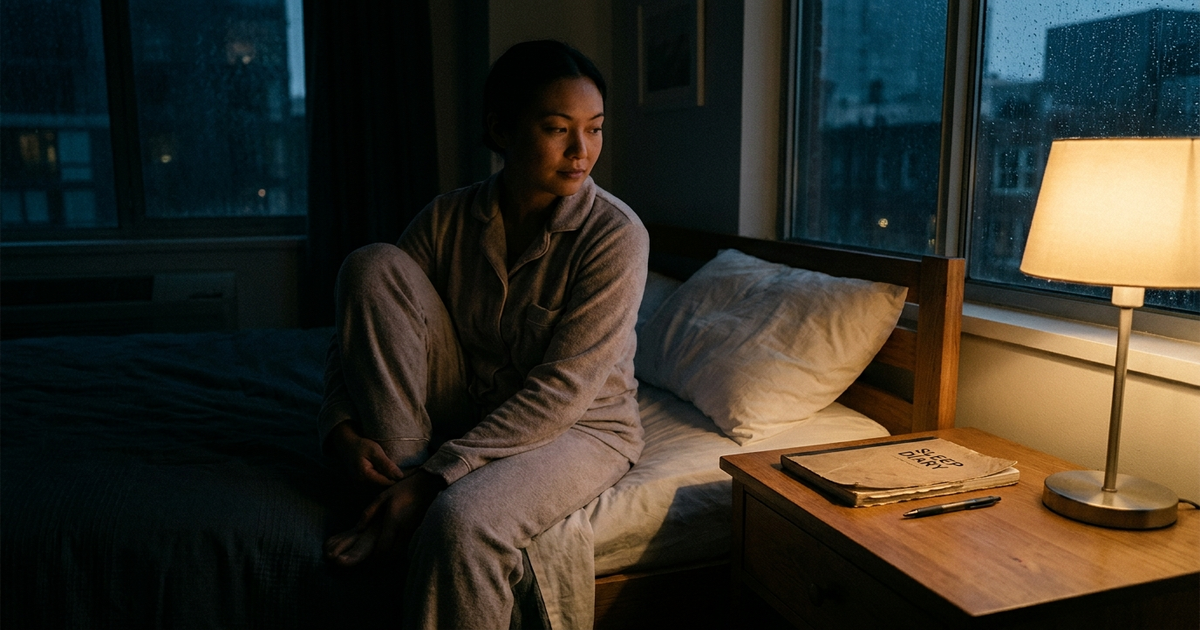
Track a plain sleep diary for five to seven nights first — bedtime, approximate time you fell asleep, any wake-ups, and final wake time. From that, work out two numbers: total time asleep, and total time in bed. Divide the first by the second and multiply by 100 to get your sleep efficiency. Say you're in bed for 8 hours but only asleep for 5.5 of them — that's 69% efficiency, well below the 85% Stanford Health Care's sleep medicine program uses as the target. Your new sleep window starts at your average total sleep time (5.5 hours in that example), anchored to a fixed wake-up time you can actually hold seven days a week. If a 5:30 alarm is realistic and you need 5.5 hours, your window is midnight to 5:30 a.m. — not before midnight, no matter how tired you feel.
Reassess weekly. If your sleep efficiency is 85% or higher across the week, add 15 minutes to the window, usually by moving bedtime slightly earlier. If it's below 80%, tighten the window by 15 minutes. Between 80–85%, hold steady another week. Most people cycle through this for four to eight weeks before landing on a window that gives them consolidated, efficient sleep — often 6.5 to 8 hours, but the number that works is whatever your own data says, not a general target.
I'm supposed to get up after 20 minutes awake — but then I'm cold and more awake. How does this actually work?
This is the rule people abandon first, usually because they try to follow it literally cold and end up standing in a dark hallway more alert than when they started. A few adjustments make it workable. Keep a robe or hoodie by the bed so getting up doesn't mean getting cold — cold wakes you up further and works against the point of the exercise. Pick one low-stimulation activity in advance rather than deciding at 2 a.m.: reading something unstimulating under dim light, a seated stretch, or folding laundry. Keep the lighting low — a single lamp, not an overhead light — since bright light at night suppresses melatonin and delays the next sleep attempt. Go back to bed only when you feel sleepy again, not just tired, and don't check the clock while you're up. The 20-minute figure is a rough guide, not something to time exactly; it's meant to interrupt the pattern of lying awake and getting frustrated, not to add a new source of clock-watching.
Sleep restriction is making me feel worse. Is that normal?
Yes, and this is the part almost no self-help guide is honest about. You're deliberately sleep-restricting, so daytime sleepiness in the first one to two weeks is expected, not a sign you're doing it wrong. Clinical research consistently flags sleep restriction as the least-liked part of CBT-I, precisely because of this adjustment period. It's also the component that does the most work. If you're driving, operating machinery, or otherwise need to be sharp, don't compress your window below about 5 hours regardless of what your sleep diary suggests, and talk to a doctor before starting if you have a seizure disorder, bipolar disorder, or a job where sleepiness is a safety risk. For most people the sleepiness eases by week two or three as sleep consolidates — if it's still severe past that point, loosen the window by 15–30 minutes rather than pushing through.
How do I stop obsessing about sleep at night?
This is the cognitive half of CBT-I, and it's more concrete than "think positive." A 2026 study in Translational Psychiatry used overnight EEG to show that CBT-I measurably reduces cortical hyperarousal during deep sleep — the brain's tendency to stay partly "on alert" even while asleep. The technique that targets this directly is catching a specific thought and testing it against evidence rather than accepting it. If the thought is "I need 8 hours or tomorrow is ruined," write down the last time you got 5–6 hours and what actually happened the next day — usually less catastrophic than the thought predicted. If it's "I'll never fix this," look at whether anything has changed in the past two weeks, even slightly. The goal isn't to force positive thoughts; it's to interrupt the loop where worry about not sleeping is itself what's keeping you awake.
Sleep coach Cali at Empower Sleep walks through five relaxation and cognitive techniques for sleep anxiety in the video above, aimed specifically at the racing-mind pattern this section describes. If that pattern is a nightly problem rather than an occasional one, our meditation for anxiety and sleep guide covers five additional techniques for calming a racing mind at bedtime.
Is sleep hygiene alone enough?
No, and this is worth saying plainly because sleep hygiene is the part of CBT-I that gets the most airtime and does the least. The Sleep Foundation's own CBT-I overview notes that hygiene — room temperature, screen cutoffs, caffeine timing — is the weakest single ingredient in the treatment. It's not useless; a hot, bright, noisy bedroom will undermine everything else you do. But if sleep hygiene is the only thing you've tried and it hasn't worked, that's not evidence CBT-I doesn't work for you — it's evidence you haven't tried the parts that actually move the needle: restriction and stimulus control. Our sleep hygiene guide covers the environmental side in full if you want to rule it out as a factor.
Which free app should I use if I'm doing this solo?
CBT-i Coach, built by the US Department of Veterans Affairs, is free and structured around the same sleep-diary and window-calculation process described above — worth noting it was originally designed to supplement work with a clinician rather than fully replace one, so treat it as a structured tracker rather than a substitute for professional support if your insomnia is severe. Insomnia Coach, also from the VA, is a separate free app built specifically for self-guided use without a therapist. Sleepio is the most clinically studied digital CBT-I program and performed well in the trials presented at the American Psychiatric Association's May 2026 meeting, though it's typically accessed through an employer or health plan rather than downloaded directly. Findings presented at the SLEEP 2026 annual meeting in June also highlighted FDA-cleared prescription CBT-I apps as outperforming generic consumer sleep apps — a distinction worth checking before you pick one, since not every app marketed as "CBT-I" follows the actual protocol.
How many weeks until this works, and can I do it on a sleeping pill?
Most people notice a change in sleep efficiency within two to three weeks and see the fuller effect by six to eight weeks, which lines up with how long the sleep-restriction adjustment period typically runs. A 2025 best-evidence summary in Frontiers in Psychiatry puts full remission at around two-thirds of people who complete the program, with adherence — sticking to the fixed wake time and the restricted window — as the main factor separating who improves and who doesn't. You don't have to taper off a sleeping pill before starting CBT-I; the April 2026 AASM guideline specifically found that CBT-I alone works as well as CBT-I combined with medication, which means you can run the behavioral techniques while continuing a prescribed sleep medication and talk to your prescriber about tapering once your sleep has stabilized, rather than needing to quit first.
Where to start tonight
Track your sleep for five nights before changing anything — you can't calculate a window without a baseline. Pick one wake time you can hold every day, including weekends. Keep a robe by the bed for the nights you need to get up. Expect the first two weeks of sleep restriction to feel worse before it feels better. That's the whole starting kit; everything else in this guide is what to do when one of those four steps runs into trouble.
Transparency note: This article was researched and written by Chester Takau with AI assistance for research gathering and drafting. All recommendations reflect the author's own editorial judgment.
Comments
Post a Comment