- Get link
- X
- Other Apps
Menopause Insomnia Why It Happens: Hormones, Fragmented Sleep and the 3 a.m. Cortisol Myth
By Chester Takau · November 2026
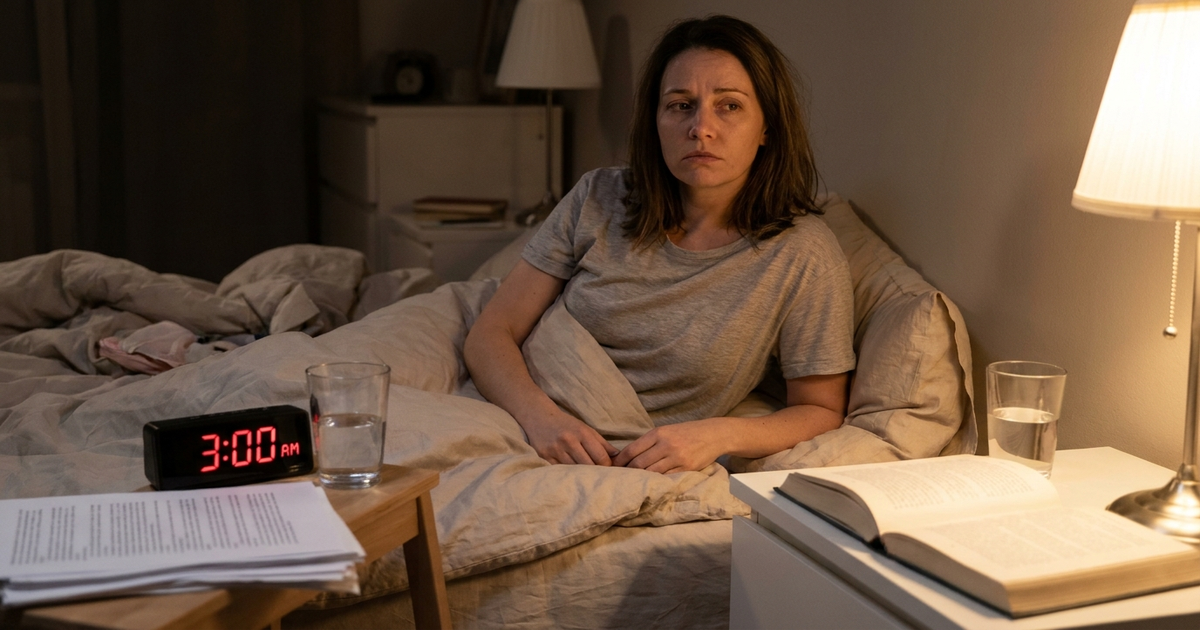
Menopause insomnia happens mainly because estradiol and progesterone fall, and both hormones help keep sleep deep and steady. Night-time hot flashes break sleep into pieces, and lower progesterone appears to make the brain easier to wake. A May 2026 conference poll of 1,202 US women aged 50 to 80 found sleep problems in about 75% of women with active menopausal symptoms, versus 49.8% of those without. Total sleep time often stays close to normal; it is the fragmentation that leaves women wrecked in the morning.
About the author
Chester Takau is an independent writer researching sleep science and meditation. Content is educational and not a substitute for medical advice. See more about this site or get in touch.
This is a research piece. I haven't run my own experiments and I'm not a clinician. What it adds is a plain-language separation of three things that most articles blur: sleep that is short versus sleep that is fragmented, clinical insomnia versus any sleep complaint, and cortisol as a cause versus a reaction. Sources are at the end.
Why do hormones change sleep at all?
Progesterone and its by-product allopregnanolone act on GABA, the brain's main calming signal. One explainer (a commercial sleep blog, so treat it as a summary, not proof) argues that as progesterone falls in perimenopause, GABA-based sleep stability weakens and waking becomes easier. It cites Matthews et al. in SLEEP reporting more beta-wave activity, a sign of a more alert brain, during non-REM sleep. Estradiol also affects the body's temperature control, which is why its drop sets off hot flashes.
Perimenopause and postmenopause are not the same problem. In perimenopause hormones swing up and down, so sleep can be good one week and bad the next. After menopause the levels stay low. Many pages blur the two, and the research I found does not yet give a clean split of which mechanism dominates when.
Is menopause sleep short, or broken?
Broken, according to the newest lab work. Rahman, Joffe and colleagues, in the Journal of Clinical Endocrinology & Metabolism (online November 2025), used an experimental model of menopause. They fragmented sleep without cutting total sleep time. Resting heart rate rose, and combined with estradiol suppression a composite cardiometabolic index worsened by about 103% more than with estradiol suppression alone. The authors say most menopausal sleep loss is fragmentation from night-time hot flashes, not shorter sleep.
A February 2026 paper in Psychoneuroendocrinology from the same research model, with 38 premenopausal women, found that fragmented sleep had a bigger effect on negative mood, while estradiol levels and hot flashes had a bigger effect on positive mood. That fits a common report: seven hours in bed, and still feeling flat and irritable.
Why do the prevalence numbers disagree?
So "26%" and "56%" are not in conflict. One counts a diagnosis, the other counts a complaint. Note also that about half of women without active symptoms in the ACOG poll still reported sleep problems, which is a reminder that age and other conditions matter too.
Why do I wake at 3 a.m. even without hot flashes?
Reader questions on this are everywhere, and the usual wellness answer is a cortisol spike. Another account reverses the order: cortisol rises because you woke, and falling progesterone lowers the threshold for waking in the first place. I can't call that settled; the cortisol-as-cause claim is common online, while the reaction account is argued mainly in commercial explainers that cite the beta-wave data. Either way, hot flashes are not the whole story, and a quiet 3 a.m. waking is still a recognised menopause-era pattern. Our shift work sleep disorder explainer covers a different cause of broken sleep worth ruling out if you also work nights or rotating hours.
The video above is from the British Menopause Society, where Dr. Zoe Schaedel answers common questions on menopause and sleep. It is more than a year old, and I couldn't check its transcript, so I'm not quoting it.
Why can't I sleep even on hormone therapy?
Hormone therapy helps many women: in November 2025 the FDA announced it would remove boxed warnings from most menopause hormone therapy products and named sleep disturbance among the symptoms it relieves. The boxed endometrial-cancer warning stays on estrogen-alone systemic products, and clinicians were split on the change. But it is not a guarantee. A sleep physician on the unPAUSED podcast (March 2026) was reported as saying up to half of women on hormone therapy still struggle with sleep. A 2026 review reportedly found estrogen plus progesterone reduces sleep disturbance more than estrogen alone, yet some commenters find progesterone too sedating and some found estrogen alone made sleep worse. If you're on therapy and still awake, the cause may be something else.
What else should be ruled out?
Sleep apnea is often missed in women and can get written off as "just menopause." Other items to raise with a doctor: restless legs and low ferritin, thyroid problems, and depression or anxiety. A symptom list for the appointment might include snoring or gasping, leg discomfort at night, and daytime low mood. Leg symptoms in particular are easy to miss, because they can look like ordinary night-time restlessness.
Many women report being told it's aging or stress. The ACOG 2026 poll authors called for routine sleep screening as part of menopause evaluation and follow-up, so asking for that is reasonable.
What treatments are being tested?
Sleep-medicine sources call cognitive behavioural therapy for insomnia (CBT-I) the first-line treatment, while some clinic sites put hormone therapy first; the two camps disagree. A five-year PCORI-funded trial led by Brigham and Women's Hospital, announced in January 2026, will compare self-guided internet CBT-I, trazodone and daridorexant in 891 peri- and early postmenopausal women. Details come from a search snippet since the page wouldn't load, and there are no results yet. Magnesium, melatonin and a cool bedroom are the usual first steps, but they don't work for everyone.
Quick answers
Is insomnia a normal part of menopause? It is common, not something you have to accept. Jean Hailes for Women's Health has a patient-facing Q&A on this.
Can it be sleep apnea instead? Yes. Ask about screening.
Should I ask for thyroid or ferritin tests? It is a reasonable question for your doctor before blaming hormones alone.
Sources: Rahman, Joffe et al., J Clin Endocrinol Metab (PMC13099197), Psychoneuroendocrinology, fragmented sleep and mood (PubMed 41265018), ACOG 2026 poll coverage, Patient Care Online, Sleep Disturbance and Perimenopause, J Clin Med 2025, Jean Hailes, Ask Dr Jean, Healthline, FDA boxed-warning change, unPAUSED podcast, March 2026, Manta Sleep explainer (commercial blog), University of Utah Health, PCORI trial.
Updated November 2026. General guidance, not medical advice. Talk to a doctor about persistent sleep problems or before starting or stopping hormone therapy.
Transparency note: This article was researched and written by Chester Takau with AI assistance for research gathering and drafting. All recommendations reflect the author's own editorial judgment.
Comments
Post a Comment