Restless Leg Syndrome vs Periodic Limb Movement: How to Tell Them Apart
By Chester Takau · October 2026
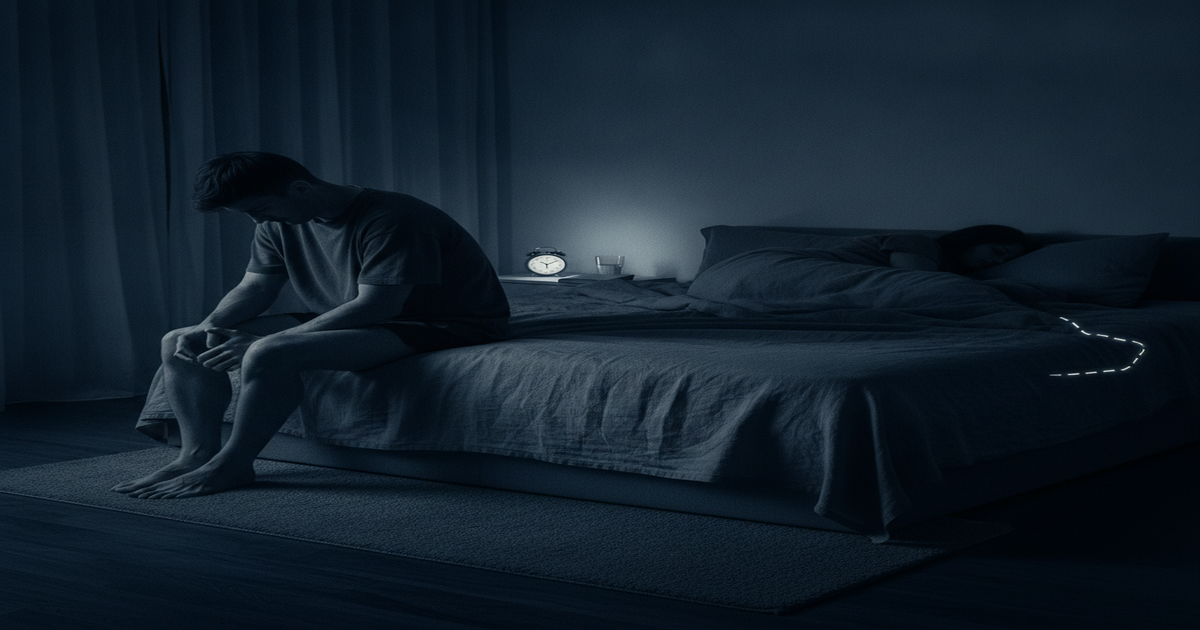
Restless legs syndrome (RLS) is something you feel while awake: an urge to move your legs, usually in the evening, that eases when you move. Periodic limb movements in sleep (PLMS) are repetitive leg jerks that happen while you sleep, and you often don't know about them until a partner or a sleep study reports them. They overlap a lot, but they are not the same thing. Periodic limb movement disorder (PLMD) is diagnosed only when RLS and other explanations have been ruled out, so you cannot have both diagnoses at once.

About the author
Chester Takau is an independent writer researching sleep science and meditation. Content is educational and not a substitute for medical advice. See more about this site or get in touch.
Which One Does Your Pattern Fit?
Tick what applies. This sorts symptoms into the patterns described in this article. It cannot diagnose anything.
General guidance, not medical advice. Only a clinician, usually with a sleep study for limb movements, can tell RLS, PLMS and PLMD apart. See a doctor about any persistent leg symptoms, loud snoring or witnessed breathing pauses.
Restless leg syndrome vs periodic limb movement at a glance
The overlap row is where consumer pages go wrong. Because 80 to 90% of people with RLS have PLMS, some pages write that "80 to 90% of people with RLS have PLMD". That contradicts the rule that the two diagnoses cannot be given together. The movements are shared; the diagnosis is not.
How can you distinguish periodic limb movements from restless legs?
Start with awareness. RLS is a sensation: people describe crawling, pulling or an irresistible need to move, and it shows up when they sit or lie still. PLMS has no sensation to report. The legs, often a big toe, ankle or knee, jerk in a repeating pattern roughly every 20 to 40 seconds, and the sleeper is usually unaware. That is why the bed partner is the better witness. A simple sort is: awake and urge-driven points to RLS; asleep, seen by someone else, and no urge points to PLMS. The checker above follows that logic.
AHAScience covers the definitions and diagnosis in this video, which was uploaded around late April 2026. I could not verify a transcript, so I am not quoting it.
Is PLMD over-diagnosed?
A June 2026 systematic review in Sleep Medicine Reviews (Fulda and colleagues) examined 180 published PLMD samples from 149 studies. 55.6% were incompatible with a PLMD diagnosis under current standards, most often because of an excluding condition such as RLS or untreated sleep apnea. Only 16.1% met criteria for possible or probable PLMD, and just 2.2% came close to definite PLMD. The practical reading: a lot of what has been labeled PLMD was something else, and a movement count alone does not make a disorder.
Sleep position and breathing are part of that "something else". If your partner reports kicking and also snoring, the breathing question comes first. Position can change apnea severity, and the numbers are in side sleeping vs back sleeping.
Can PLMD happen while you're awake?
A Mayo Clinic Connect poster asked this after jerking while lying awake in the morning and when drowsy after meals. Movements while awake, with or without an urge, are worth describing to a doctor precisely because they are not the sleep-only PLMS pattern. Limb movements can also occur in wakefulness, and a clinician has to sort out whether the history points to RLS. I would not self-label it from a forum thread.
How are they treated, and what changed in 2026?
The 2026 RLS Foundation algorithm, published in Mayo Clinic Proceedings, puts iron first, including IV iron where appropriate. Gabapentinoids come next. Low-dose opioids such as buprenorphine are for carefully selected patients. Dopamine agonists keep a "limited role" with strict monitoring because of augmentation, where symptoms start earlier and get worse. The AASM 2025 guideline advises against their standard use, with augmentation affecting roughly 7 to 10% of users a year. Coming off one can take 6 to 12 months, according to John Winkelman.
There is a wrinkle for limb movements. Dopamine agonists can suppress PLMS, and a 2026 npj Parkinson's Disease review notes they may help both Parkinson's symptoms and PLMs (PLM prevalence in Parkinson's ranges from 17.6% to 86.7% across studies). Suppressing movements on a sleep study is not the same as improving sleep, and for RLS the augmentation risk is the reason the guidance moved away from them. The Silber interview on the algorithm does not discuss PLMs, so applying it to PLMS alone is my inference, not a published recommendation.
For refractory RLS, a September 2026 interim analysis of the THRIVE study in Sleep looked at tonic motor activation, a peroneal nerve stimulation device, in 232 patients whose RLS had not responded to medication. Scores on the IRLS scale fell by 8.4 points, 79% improved by at least 3 points, and 8% had device-related adverse events, none serious. It was open-label, so a placebo effect can't be excluded.
Quick answers
Does PLMD cause daytime sleepiness?
It can, which is part of the definition: PLMD needs sleep disturbance or daytime impairment. A 2026 Sleep Medicine: X study found PLMS in non-REM sleep was linked to lower sleep efficiency than in controls, and PLM-related arousals were more frequent in patients.
Are the cutoffs the same for children?
No. Adults use a PLM index above 15 an hour; pediatric guidance uses 5 or more. Some consumer pages say "more than five per hour" with no age given.
Is it just low iron or low dopamine?
Iron is the first thing checked, but one wellness creator's claim that these are "often caused by a deficiency in dopamine or low iron" oversimplifies the science. Early work, such as a June 2026 zebrafish study, points to the cerebellum, and it has not been tested in humans.
Does pregnancy matter?
A Japanese study of 2,435 pregnant women linked third-trimester RLS to about three times the risk of perinatal depression. Second-trimester RLS showed no such link. It is an association, not proof of cause.
Can a wearable detect PLMs?
That is an open question. The SONEX trial is testing a wearable alongside polysomnography, but until results exist, a lab or validated home study is the standard way to count movements.
The bottom line
If you feel an urge to move your legs that eases when you do, think RLS and ask about iron. If someone else sees your legs jerk in sleep and you feel nothing, think PLMS, and ask whether breathing or RLS explains it before accepting a PLMD label. Tell the doctor which of those two descriptions fits, since it changes the workup.
Sources: Fulda et al., Sleep Medicine Reviews, 2026, 2026 RLS Foundation algorithm (NeurologyLive), THRIVE interim results (NeurologyLive), npj Parkinson's Disease, 2026, AASM RLS guideline, HCPLive, Winkelman on dopamine agonists, Merck Manual, Sleep Medicine: X, 2026, News-Medical, perinatal depression, Medical Xpress, zebrafish study, SONEX trial NCT07382206, Mayo Clinic Connect.
Updated October 2026.
Transparency note: This article was researched and written by Chester Takau with AI assistance for research gathering and drafting. All recommendations reflect the author's own editorial judgment.
Comments
Post a Comment