What Is Non Sleep Deep Rest (NSDR)? What It Is and What 2026 Trials Found
By Chester Takau · November 2026
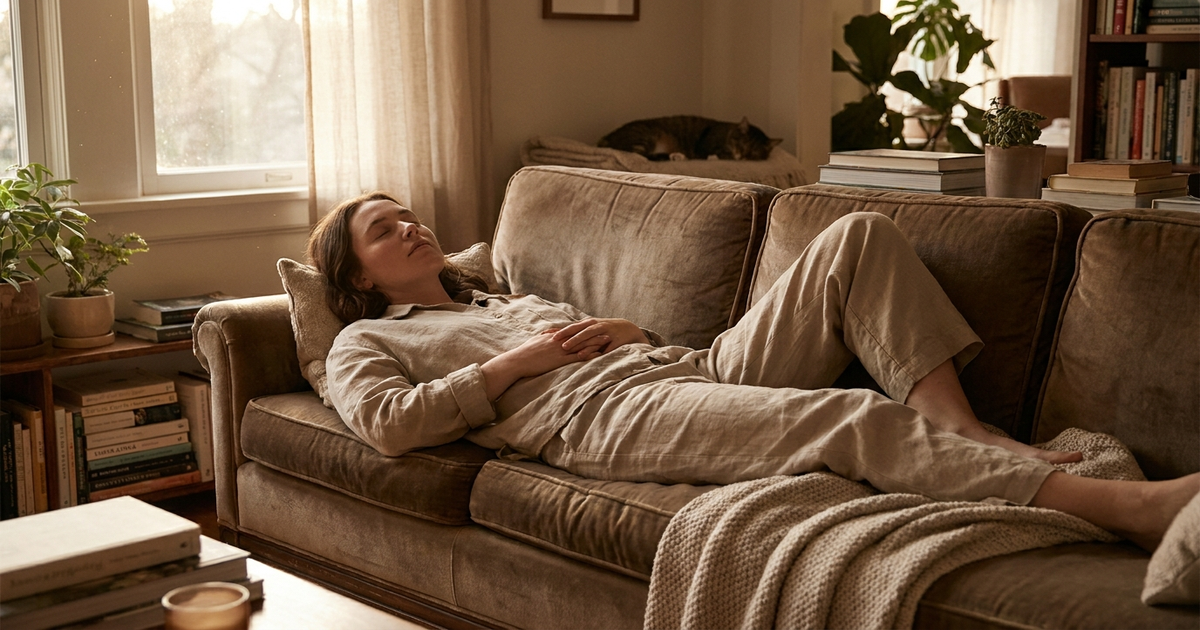
Non sleep deep rest (NSDR) is a guided relaxation, usually 10 to 30 minutes long, where you lie still with your eyes closed and follow a voice through slow breathing and a body scan. You stay awake. The name comes from Andrew Huberman, and critics point out it overlaps heavily with yoga nidra. NSDR is not sleep and does not replace it, and trials that test it by name show small, short-lived effects.
About the author
Chester Takau is an independent writer researching sleep science and meditation. Content is educational and not a substitute for medical advice. See more about this site or get in touch.
What does a session sound like?
Huberman's original track opens like this.

"welcome to this 10-minute non-sleep deep rest protocol"
Is NSDR just yoga nidra?
Close to it. Sara Mednick, PhD, of UC Irvine, calls NSDR "a repackaging and appropriation" of meditation traditions. Huberman has called the term his attempt at friendlier language and says it is not meditation. The distinction matters for evidence, because most research behind the claims studies yoga nidra, not short tracks labelled NSDR. A 2026 meta-analysis of 73 yoga nidra studies (5,201 participants) found moderate to large drops in stress, anxiety and depression, but the authors warn study quality was low and the effects are probably inflated (Ghai et al.).
What have trials of NSDR itself found?
| Trial (2026) | Design | Result |
|---|---|---|
| Boukhris et al. | 102 active young adults; one 10-minute session vs control | Better felt fatigue, stress and vigor; cognitive effects did not last; modest physiological change; jump performance unchanged |
| Boukhris, Suppiah & Driller | 60 active adults; 25-minute nap vs 10-minute NSDR vs nothing | Nap lowered fatigue and raised readiness at 40 minutes; NSDR showed no significant effect vs controls |
So NSDR can make you feel better for a while, but a short nap beat it on readiness. A site summary (nsdr.co) counts only about four trials using the name.
Does NSDR raise dopamine or replace sleep?
The often-quoted "65% more dopamine" figure comes from a 2002 PET study of eight experienced practitioners, so treat it as a lead, not a promise. Claims that an hour of NSDR equals four hours of sleep are not supported, and a Stanford sleep researcher quoted by Rise Science says most aspects of sleep can't be replaced.
Can it backfire at night?
Yes, for some people. One reviewer in a month-long test found that lying awake in bed made sleep anxiety worse, and a nightly 20-minute routine started to feel like a chore. If that sounds familiar, stimulus control therapy is one approach that targets that pattern. Talk to a clinician if you have chronic insomnia or a trauma history, since lying still with eyes closed does not suit everyone.
Sources: Ghai et al. yoga nidra meta-analysis, Boukhris et al. single-session RCT, nap vs NSDR preprint, Huberman Lab NSDR page, Fatherly on the Mednick critique, InsideHook month-long test, Rise Science.
Updated November 2026. General guidance, not medical advice.
Transparency note: This article was researched and written by Chester Takau with AI assistance for research gathering and drafting. All recommendations reflect the author's own editorial judgment.
Comments
Post a Comment