- Get link
- X
- Other Apps
What Does Sleep Score Mean? How Fitbit, Oura, Apple, and Google Actually Calculate It
By Chester Takau · July 2026
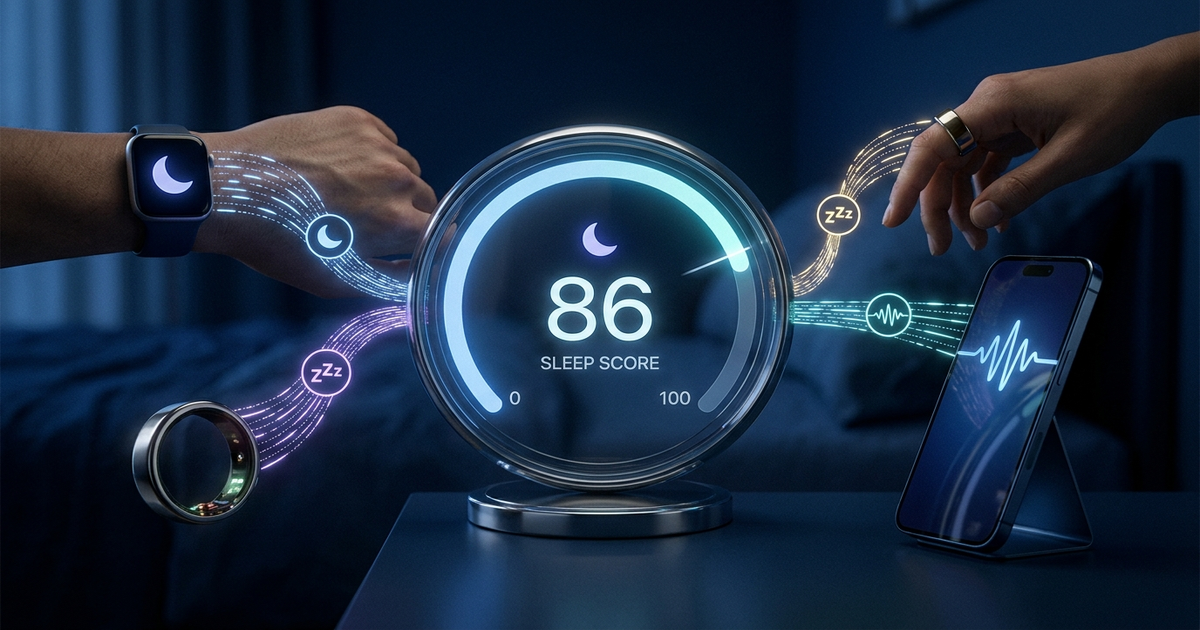
A sleep score is a single 0–100 number that your watch, ring, or app produces by weighing three things: how long you slept, how consolidated that sleep was (interruptions and restlessness), and how consistent your timing was. It is not a medical measurement — it is each company's own formula for summarizing a night, and the formulas disagree with each other by design. Fitbit, Apple, Oura, and Google all compute it differently, weight it differently, and label "good" differently, which is why the same night on two wrists can produce two very different numbers.
The short answer
- It's a weighted blend of duration, sleep continuity, and timing consistency — duration usually carries the most weight
- Every brand uses its own formula, so an Oura score and an Apple score for the same night are not directly comparable
- It can't diagnose sleep apnea, tell you why you feel tired, or replace a clinical sleep study
- It's most useful as a 7–14 day trend line, not a nightly report card
- Obsessing over the number has a name — orthosomnia — and it's a documented way trackers make sleep worse
What actually goes into the number
Every major sleep score is built from the same three ingredients in different proportions: total sleep duration, sleep continuity (how often you woke or stirred), and timing consistency (whether your bedtime and wake time stay roughly fixed). Apple's version, which arrived with watchOS 26 in September 2025, makes the weighting public: duration is worth up to 50 of the 100 points, bedtime consistency up to 30, and interruptions up to 20. Fitbit rolled out a redesigned score in April 2026 that, for the first time, shows the sub-metrics behind the number directly — total sleep duration, time to sound sleep, sound sleep itself, restlessness, interruptions, and full awakenings — with duration still making up the majority of the total. Fitbit was explicit that this isn't a cosmetic update: because the underlying math changed, your score may shift even if your actual sleep didn't, and old and new numbers don't map onto each other cleanly.
Oura's score works on a similar principle but calls its inputs "contributors" — total sleep, efficiency, restfulness, REM and deep sleep amounts, latency, and timing — rolled into one number, with the company's own guidance treating 85 and above as "optimal." Google folded a comparable score into the Google Health app in 2026, sitting alongside the existing Pixel and Fitbit scoring rather than replacing it. None of these four systems share a formula, which is the direct cause of the next problem.
If you want to see the arithmetic laid out rather than take a company's word for it, the video above reverse-engineers Apple's sleep score from raw sensor data — duration, consistency, and interruptions — and shows how each component moves the final number.
Why your Oura score and Apple Watch score don't match
A week-long side-by-side test by Tom's Guide in October 2025 found Oura's sleep scores running consistently lower than Apple Watch's for the identical nights, worn by the same person, at the same time. That gap isn't a malfunction on either device — it's what happens when two companies build different formulas from different sensor data (a ring reads different signals than a wrist) and calibrate "optimal" differently. Treat a sleep score as brand-relative, the way you'd treat a grading curve that changes by classroom. Comparing your Oura score to a friend's Apple score, or to your own number from before you switched devices, tells you very little. Comparing this week's score to last week's, on the same device, tells you much more.
Why you can score high and still feel exhausted
This is the complaint that shows up most in tracker forums, and it's usually a measurement problem rather than a contradiction. The score is built almost entirely from duration and continuity — how long you were asleep and how unbroken it was. It is not built from sleep apnea events, circadian misalignment (sleeping the "right" number of hours at the wrong point in your body clock), or how your nervous system processed that sleep. You can log seven consolidated hours and still wake up flattened because a treatable condition like sleep apnea was fragmenting your sleep in ways your wrist or finger never detected, or because your sleep window was badly out of sync with your circadian rhythm. A high number rules out "you didn't sleep long enough." It does not rule out much else.
Can a sleep score catch sleep apnea?
No, and no consumer sleep score is designed to. A handful of devices flag irregular breathing as a separate metric, but that's a distinct feature from the score itself, not something baked into the 0–100 number. If you snore heavily, wake up gasping, or a partner has noticed pauses in your breathing, that's a conversation for a doctor and possibly a sleep study — not something a good weekly average will reassure away. A separate kind of "sleep score" exists inside CPAP apps like ResMed's myAir, which measures therapy compliance and mask usage for people already diagnosed with apnea. It's worth knowing the two aren't the same product solving the same problem, even though they share a name.
How accurate is the data behind the number
Sleep experts flagged this publicly in January 2026: consumer trackers are not accurate enough for clinical diagnosis, and they tend to misread quiet wakefulness — lying still, eyes closed, mind awake — as light sleep, which inflates both total sleep time and the resulting score. That isn't a fringe complaint. A peer-reviewed multicenter validation of eleven consumer sleep trackers found accuracy for sleep-stage estimates (the light/deep/REM splits that feed several of these scores) ranging from a macro F1 score as high as 0.69 down to as low as 0.26 depending on the device — a wide enough spread that "the algorithm said" shouldn't be read as clinical fact. The number is a reasonable estimate built on genuinely limited sensor data, not a lab-grade readout.
When tracking the score makes your sleep worse
There's a documented pattern for this: orthosomnia, a term coined to describe losing sleep over anxiety about your sleep score. Research on the phenomenon links it to perfectionism, health anxiety, and obsessive checking — the exact behaviors a glowing number on your nightstand can quietly encourage. If a low score is making you dread checking your phone, or you've started going to bed earlier purely to chase a higher number rather than because you're tired, the tracking has stopped helping. This is the same territory we cover in more depth in our guide to personalizing your sleep tracking without letting a device dictate how you feel about a night's rest. If racing thoughts about sleep — whether from a bad score or anything else — are the real problem at bedtime, our meditation for anxiety and sleep guide covers techniques built specifically for that.
A realistic way to use it
Treat the score as a trend, not a grade. Look at it across a week or two rather than reacting to any single night, and pay more attention to the direction it's moving than the exact figure. If you want a number with more clinical grounding to track alongside it, sleep efficiency — the ratio of time asleep to time in bed — is the same metric CBT-I programs use to adjust sleep restriction therapy windows, and it's less brand-dependent than a proprietary score. And if your sleep issues go beyond what any tracker can explain — chronic insomnia that's lasted more than a few weeks, for instance — a device score isn't the right tool at all; our CBT-I guide covers the evidence-based next step. The number on your wrist is a starting conversation with your own sleep, not the final word on it.
Transparency note: This article was researched and written by Chester Takau with AI assistance for research gathering and drafting. All recommendations reflect the author's own editorial judgment.
Comments
Post a Comment