- Get link
- X
- Other Apps
How to Sleep Well While Traveling: A Practical Guide
By Chester Takau · August 2026
Sleeping well while traveling means managing four things at once: an unfamiliar room your brain hasn't learned to trust yet, cabin or hotel noise and light you can't control, a body clock that's out of sync with local time, and a schedule that isn't yours. A 2025 study of 1.5 million nights of Oura ring data found that sleep duration bounces back within a day or two of a trip, but sleep timing and the deep/REM structure underneath it take much longer to realign — which is why you can "catch up" on hours and still feel wrong. The fixes below target each piece separately rather than treating travel sleep as one problem with one hack.
Chester Takau
Chester Takau is an independent writer researching sleep science and meditation. Content is educational and not a substitute for medical advice.
Most travel-sleep advice repeats the same short list — avoid caffeine, dim your screen — without addressing what actually derails a trip: the first hotel night, a nap decision made at the worst possible moment, or a wearable "readiness" score that panics you over nothing. This guide pulls in the newer Oura/NUS timing data, the CDC's 2026 Yellow Book guidance, and the gaps most travel articles skip entirely — road trips, the flight home, and traveling with kids on short notice.
Travel Sleep Kit Builder
Pick how you're traveling and answer one question to get your actual checklist — not a generic packing list.
General guidance based on published sleep and travel-medicine sources, not medical advice. See a doctor for persistent sleep problems.
At a Glance: Ranked Comparison
| # | Model | Best for | Why it ranks |
|---|---|---|---|
| 2 | What actually helps you sleep in economy | and what's a scam | |
| 6 | Road trips and overnight buses get ignored | here's what actually applies | |
| 7 | The flight home is harder than people plan for |
1. Why you can't sleep the first night, even when you're exhausted
Brown University researchers found that one hemisphere of your brain stays partially alert during your first night in a new place — a leftover watchdog reflex, more pronounced than most people realize. It's widely reported as a curiosity, but rarely translated into a plan. The actual fix is reducing novelty: book the same hotel chain or room type you're used to when you have the choice, and bring one genuine "home cue" with you — your own pillowcase, a familiar scent, the same pre-sleep routine you'd run at home. It's a small thing, but it's the one piece of first-night advice built directly on the mechanism, not just "try to relax."
2. What actually helps you sleep in economy — and what's a scam
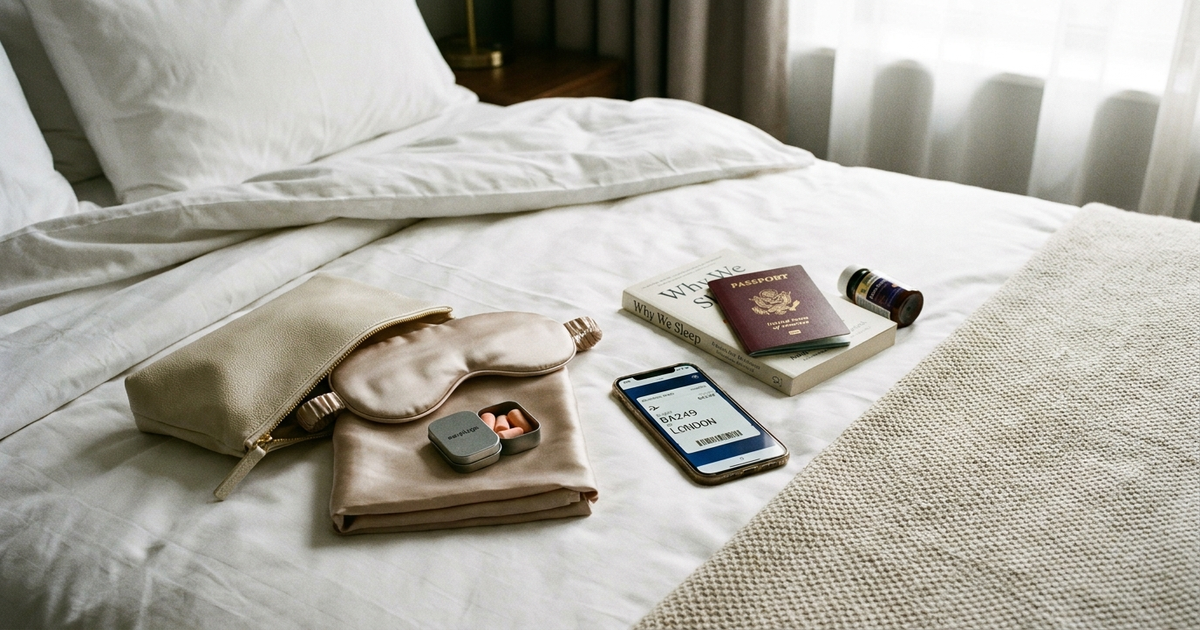
Noise-canceling headphones or earplugs paired with a snug eye mask are the closest thing travel writers agree on as a universal win — cheap, reusable, and they solve the two things you genuinely can't control on a plane: ambient noise and cabin light. Neck pillows are more mixed — they can stop your head from dropping and jolting you awake, but they don't touch noise or light, which do more of the actual damage to sleep quality. Flight attendants interviewed in 2025 named two habits above the rest: skipping inflight alcohol, because it wrecks sleep architecture and dehydration even though it feels sedating, and setting your watch to destination time the moment you board so you're not fighting your old schedule for the whole flight.
3. Should you nap when you land, or push through to local bedtime?
This is genuinely contested. One camp says sleep on the plane and nap if you land wrecked; the circadian camp — including Andrew Huberman's widely cited protocol — argues you should never nap on arrival and instead chase daylight until local bedtime, because a nap tells your body clock it's still fine to run on the old schedule. The 2025 Oura/NUS analysis of 1.5 million nights backs the "push through" side indirectly: it found that sleep duration recovers quickly after travel regardless, but timing and the deeper sleep-stage structure take much longer to catch up — meaning a nap that fixes how tired you feel does little for the clock underneath it.
Huberman's protocol is built around timing light exposure relative to your body's daily temperature minimum to deliberately shift your clock toward the new zone, rather than around fighting sleepiness with naps.
"If you expose your eyes to bright light in the four hours, maybe five or six, but in the four hours after your temperature minimum, your circadian clock will shift so that you will tend to get up earlier and go to sleep earlier in the subsequent days."
If you're still deciding whether a nap fits your specific situation rather than the general rule, it's worth reading through whether napping after a long trip actually helps or backfires before you land, since the right call depends on how bad the sleep debt already is.
4. What your Oura or Whoop is actually telling you after a trip
Wearables are common enough now that a bad "readiness" score after a trip can cause more worry than the jet lag itself. The Oura/NUS dataset is useful here precisely because it separates two things your ring lumps together: sleep duration, which typically rebounds within a day or two, and sleep timing plus deep/REM architecture, which take noticeably longer to realign — especially after eastward travel or a large time-zone jump, which the same data shows is disproportionately harder than the old "one day per zone" rule suggests. In practice: don't panic over one or two rough readiness scores right after landing. Watch whether your timing and deep-sleep percentage are trending back toward normal over the following week, which is a better signal than the daily number.
If you want the fuller mechanics of how your internal clock resets after a shift like this, our guide to getting your body's internal clock back on schedule covers the underlying process this data is measuring.
5. Traveling with kids, or with 24 hours' notice instead of five days
The CDC's 2026 Yellow Book recommends shifting your sleep schedule several days before a major trip, and that advice is sound — but it assumes a runway most working parents don't have. If you don't have five days, don't try to force it: skip the pre-shift entirely and put the effort into arrival instead. Get outside into daylight as soon as you land, hold off on caffeine late in the day, and go to bed close to local bedtime even if it means pushing through some tiredness. For kids specifically, don't attempt a multi-day pre-shift at all — anchor them to local daylight and their usual wind-down routine (same blanket, same book, same order of steps) from the moment you arrive. Young kids adapt to routine cues faster than adults adapt to abstract schedule math.
6. Road trips and overnight buses get ignored — here's what actually applies
Almost every travel-sleep guide assumes you're on a plane or in a hotel. A moving vehicle has the same core problems — light, noise, an unfamiliar sleeping position — plus one plane and hotel guides don't have to deal with: fatigue behind the wheel. The same earplugs-and-eye-mask kit works in a car seat or bus berth as well as it does at 35,000 feet. The one non-negotiable difference is that if you're driving, drowsiness is a stop signal, not a caffeine problem — pull over, swap drivers, or rest before continuing, rather than pushing through on the assumption you'll wake up once you're moving again.
7. The flight home is harder than people plan for
Nearly every article about travel sleep optimizes the outbound leg and drops the subject once you've "arrived." But your body clock doesn't know the trip is over — it has to make the same adjustment in reverse, and the eastward-versus-westward asymmetry that made the outbound leg easier or harder applies again on the way back, just flipped. If the outbound direction was the easy one for you, expect the return to be the harder one. The same toolkit applies both ways: light timing, skipping the nap on landing, and a consistent local bedtime rather than assuming the return trip needs no plan just because you already "did jet lag" once this trip.
Quick questions
How much melatonin should I actually take while traveling?
Recent reviews find low doses of 0.5–1 mg work as well as the 5–10 mg gummies sold in most stores, with higher doses mostly adding next-morning grogginess rather than a faster adjustment.
Do I need a jet lag plan for a 1–2 hour time difference?
Not really. A shift that small rarely disrupts your clock enough to justify a protocol — normal sleep hygiene (dark, cool, quiet room, consistent bedtime) covers it.
Sources: Oura × National University of Singapore, 1.5-million-night jet lag study (2025) · CDC Yellow Book 2026, Jet Lag Disorder · Brown University / NIH, first-night effect research (2016) · Sleep Foundation, melatonin dosage guidance (2025) · Afar, sleeping better on a plane · Tom's Guide, flight attendants' sleep tips (2025)
Updated August 2026.
Transparency note: This article was researched and written by Chester Takau with AI assistance for research gathering and drafting. All recommendations reflect the author's own editorial judgment.
Comments
Post a Comment