- Get link
- X
- Other Apps
Night Owl vs Early Bird Chronotype: What the Science Actually Says
By Chester Takau · August 2026
Night owl vs early bird isn't really a two-way split. A February 2026 McGill study in Nature Communications, built on brain imaging and questionnaire data from roughly 27,000 UK Biobank participants, used machine learning to sort chronotype into five distinct subtypes — two morning-leaning and three evening-leaning — each with its own health signature. The old binary still works as shorthand, and most people can place themselves on the owl-to-lark spectrum easily enough, but which specific subtype you land in matters more for your health than simply knowing you're "a night person."
The verdict
- Chronotype is roughly 40–50% genetic (Oxford's Russell Foster) — it's biology, not a discipline problem
- 2026 research finds five subtypes, not two, and health risk tracks the subtype, not just owl-vs-lark
- One male-skewed "eveningness" subtype carries higher cardiovascular and substance-use risk; a female-skewed morning subtype tracks with depressive symptoms
- Evening types scored 7–13.5% higher on cognitive tests in a 26,000-person Imperial College London study — but that's association, not proof owls are smarter
- The "owls die younger" mortality finding is real but contested — misalignment with your schedule, not chronotype itself, looks like the actual driver
Chester Takau
Chester Takau is an independent writer researching sleep science and meditation. Content is educational and not a substitute for medical advice.
Quick Chronotype Check
Three questions, a rough read on where you sit on the owl-to-lark spectrum. Not a diagnostic test.
A simplified self-check, not the validated Morningness-Eveningness Questionnaire (MEQ) clinicians use. 2026 research suggests real chronotype splits into five subtypes rather than a clean two-way split — treat this as a starting point, not a label.
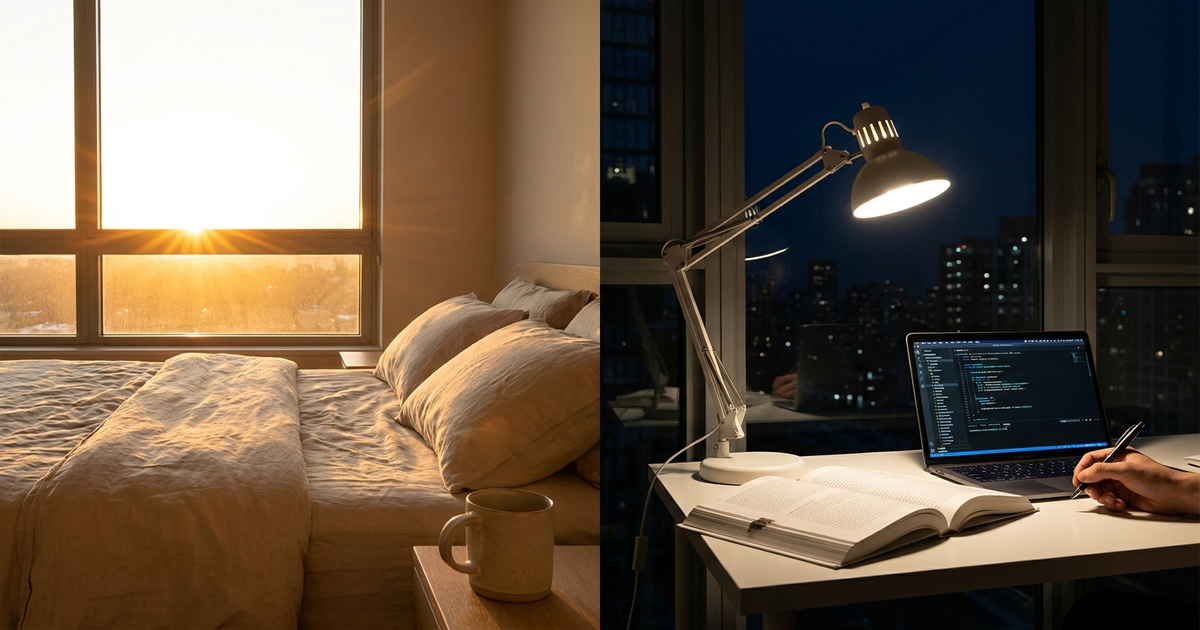
Night owl vs early bird, side by side
Is being a night owl genetic, or just a bad habit?
Genetic, mostly. Oxford circadian neuroscientist Russell Foster puts the heritable component at roughly 40–50%, which makes chronotype closer to height than to a lifestyle choice you can discipline your way out of. Foster's advice is blunt: don't fight your chronotype, use morning light exposure to nudge it gently, and stop treating "night owl" as a character flaw. The 2026 McGill subtyping work backs this up mechanistically — the study paired brain-imaging differences with the questionnaire data, meaning the split shows up in physiology, not just in self-reported habits.
Foster's own explainer above walks through the biological basis of chronotype in more depth than any single article can — worth watching if you want the mechanism behind the genetics claim rather than just the headline.
Do night owls really die younger, or are night owls smarter — which is it?
Both headlines get cited, and neither is as clean as the framing suggests. The mortality claim comes from a Chronobiology International analysis of roughly 500,000 adults that found about a 10% higher mortality risk for night owls — but outside experts who reviewed it said the effect "wasn't as robust as I would have hoped," and the more likely culprit is social jetlag: the mismatch between your body clock and a schedule built for larks, not the chronotype itself. Separately, a 2024 Imperial College London study in BMJ Public Health, covering more than 26,000 people, found evening types scored 7–13.5% higher on cognitive tests — a real finding, but association, not proof that staying up late makes you sharper. Read together, the honest summary is: chronotype correlates with some outcomes in both directions, and misalignment with your actual schedule explains more of the risk than which type you are.
Can you change your chronotype, or does it just shift with age?
You can nudge it a few hours with consistent light timing, but you can't flip a strong owl into a strong lark. Age does more of the shifting than willpower does: teenagers skew markedly toward eveningness, then chronotype gradually creeps earlier through adulthood and into a lark-leaning pattern in older age — a well-documented trend, though the exact mechanism behind the shift is still debated. If you're trying to work with your clock rather than against it long-term, the guide to resetting your body's internal clock covers the light-timing mechanics Foster's approach depends on.
I'm a night owl stuck in a 9-to-5 — how do I cope without wrecking my health?
This is the actual practical problem behind most of the owl-vs-lark debate, and it's under-covered compared to the risk listicles. An April 2026 randomized trial in Open Heart — 134 adults aged 40–60 with cardiovascular risk factors — found that timing exercise to match your chronotype produced significantly better blood pressure, heart-rate variability, VO₂ peak, LDL, and fasting glucose results than exercising at a chronotype-mismatched time. Practically: an owl forced into early mornings gets more benefit from moving harder workouts later in the day when the body's actually ready for them, rather than defaulting to a 6am gym session because that's when a lark's schedule says to go. Strategic short naps can also offset the sleep debt this mismatch creates, though timing and length matter — whether a nap actually helps or backfires depends on how late in the day you take it.
Which is better for productivity — early bird or night owl?
Neither, structurally — the "early birds win at life" claim mostly reflects a world built around 9-to-5 schedules, not innate superiority. Studies tying early rising to higher income and lower depression are real, but they're measuring people whose biology happens to match the demands of standard work and school hours, not measuring chronotype in a vacuum. An owl working a schedule aligned to their own peak hours, or navigating the practical fixes for keeping sleep on track while traveling across time zones, can be just as productive as a lark — the deciding factor is alignment between schedule and biology, not which type does better in the abstract.
Quick questions
Is social jetlag actually harming me?
If your weekday and weekend sleep times differ by more than an hour or two, yes — social jetlag is the mismatch researchers increasingly point to as the real driver behind the "owls have worse health outcomes" headlines, more than chronotype itself.
Which quiz should I trust — MEQ or the bear/lion/wolf/dolphin type?
The Morningness-Eveningness Questionnaire (MEQ) is the validated clinical tool; the animal-based quizzes are popular simplifications of the same underlying spectrum, useful for a quick read but not a clinical instrument.
Sources: McGill University / Nature Communications, five-subtype chronotype study (Feb 2026) · University of Barcelona, chronotype and muscle/metabolic health (Jan 2026) · Open Heart, chronotype-aligned exercise RCT (Apr 2026) · Imperial College London / BMJ Public Health, chronotype and cognition (2024) · Chronobiology International, chronotype and mortality (via Medical News Today) · Sleep Foundation, chronotypes explainer
Updated August 2026.
Transparency note: This article was researched and written by Chester Takau with AI assistance for research gathering and drafting. All recommendations reflect the author's own editorial judgment.
Comments
Post a Comment