- Get link
- X
- Other Apps
What Is Sleep Onset Latency and Normal Range? The 10–20 Minute Rule Explained
By Chester Takau · August 2026
[IMAGE-PLACEHOLDER: sleep-onset-latency-normal-range.png
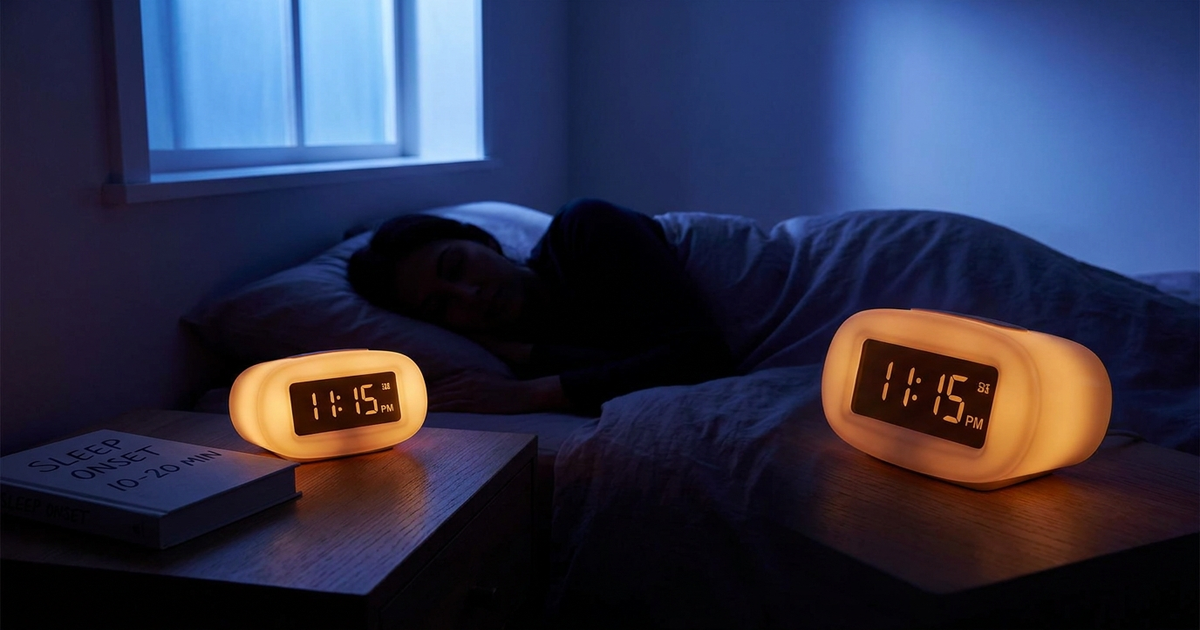
Bedside clock glowing softly in a dark bedroom next to a peacefully sleeping silhouette, blue night light
Bedside clock glowing softly in a dark bedroom next to a peacefully sleeping silhouette, blue night light
Sleep onset latency (SOL) is the amount of time it takes you to fall asleep after settling in and turning out the lights, measured from lights-out to the first stretch of measurable sleep. For a healthy adult with no sleep disorder, the normal range is about 10 to 20 minutes. Falling asleep faster than that isn't a bonus — sleep clinicians treat it as a sign of sleep debt or an underlying issue, not a sign of being a great sleeper. Regularly taking longer than 20 to 30 minutes is one of the markers used to flag insomnia.
The short answer
- Normal SOL for healthy adults: 10–20 minutes; a 2023 meta-analysis of 110 cohorts puts the mean at roughly 11.7–11.8 minutes
- Falling asleep in under 5 minutes usually signals sleep deprivation or an untreated condition like sleep apnea, not efficient sleep
- Taking longer than 20–30 minutes on most nights is one of the clinical criteria used to assess insomnia
- Consumer wearables estimate SOL from movement, not brainwaves — wake-detection accuracy runs as low as 27–52%, so treat the number as a trend, not a lab reading
- Age, sex, and BMI don't meaningfully predict SOL — the range holds steady across healthy adult groups
Why isn't falling asleep instantly a good sign?
It's a natural assumption — the faster you're out, the better you must sleep. Behavioral sleep medicine specialist Michelle Drerup, PsyD, at Cleveland Clinic pushes back on that directly: falling asleep within a minute of lying down usually points to sleep deprivation or an underlying issue, not skill. People with untreated sleep apnea are a common example — they can drop off almost instantly because they aren't getting restorative sleep in the first place, so their body is running a constant sleep deficit. A body that's genuinely well-rested still needs a bit of runway to wind down; instant unconsciousness is closer to passing out than falling asleep.
What actually counts as "too long"?
There's no single cutoff, but 20 to 30 minutes on most nights is the point where sleep specialists start asking questions, and it's one of the diagnostic criteria for insomnia when it happens at least three nights a week for three months or more. It's also worth knowing the number itself moved recently: the American Academy of Sleep Medicine updated its technical definition of sleep onset, and that change measures slightly longer latencies than the older standard — which matters for anyone comparing an old sleep study to a newer one, or a newer diagnostic threshold like narcolepsy testing. If you're consistently over 30–40 minutes, that's less "give it another few minutes" territory and more a conversation with a doctor.
Can you trust your wearable's sleep latency number?
Only loosely. Oura, Apple Watch, and Fitbit are reasonably good at estimating total sleep time, but 2026 accuracy reviews put their wake-detection specificity at just 27–52% — meaning they frequently mistake lying still and relaxed for being asleep. That's why some users see a "0-minute" or under-5-minute latency reading flagged as a problem on their app (a recurring complaint in Samsung's own community forum) when the real explanation is often a measurement artifact, not physiology. Oura's own guidance lines up with the clinical range: under 5 minutes is flagged as likely overtired, and over 20 minutes consistently is flagged as possible insomnia — treat both as a prompt to look closer, not a diagnosis.
Why this number matters for insomnia treatment
SOL isn't just trivia — it's one of the numbers CBT-I therapists track alongside sleep efficiency to gauge whether treatment is working. If your latency is drifting down toward that 10–20 minute band over the course of sleep restriction therapy, that's one of the clearest objective signs the protocol is doing its job, independent of how the night felt subjectively. A wind-down routine that reliably shortens SOL without dropping it to zero is the target, not the fastest possible onset. If you're building one, a 20-minute guided sleep meditation script is a reasonable way to occupy the pre-sleep window without turning it into more screen time, and a beginner-friendly walkthrough of guided meditation practice is worth working through first if you've never tried one.
Daytime sleep habits factor in too — carrying too much sleep debt from long naps can blunt your sleep drive and stretch out nighttime latency, which is part of why our piece on whether napping helps or hurts your sleep is worth reading alongside this one if naps are part of your routine.
For a deeper look at what's happening biologically during that 10-to-20-minute window — the buildup of sleep drive, sleep architecture, and what actually helps the brain switch states — the Huberman Lab episode above is a solid evergreen overview of the underlying science.
Transparency note: This article was researched and written by Chester Takau with AI assistance for research gathering and drafting. All recommendations reflect the author's own editorial judgment.
Related on MindfulJourneySleep: The Missing Piece of My Sleep Puzzle; What Is a Sleep Divorce? The Separate-Bedroom Trend Explained
Comments
Post a Comment