Yoga Nidra vs Meditation for Sleep: Which One Actually Gets You There
By Chester Takau · July 2026
For falling asleep specifically, yoga nidra is the better choice for most people: it's done lying flat, fully guided, and built around eventually losing awareness — which is the opposite goal of most seated meditation, where staying alert is the point. A 2026 systematic review pooling six randomized controlled trials found yoga nidra improved sleep-onset time, total sleep time, and sleep efficiency, though the authors were clear that larger, higher-quality trials are still needed. Seated meditation still has a place — it's the better tool for daytime anxiety and racing thoughts you need to work through while awake — but if the goal tonight is unconsciousness, yoga nidra is built for that job and meditation isn't.
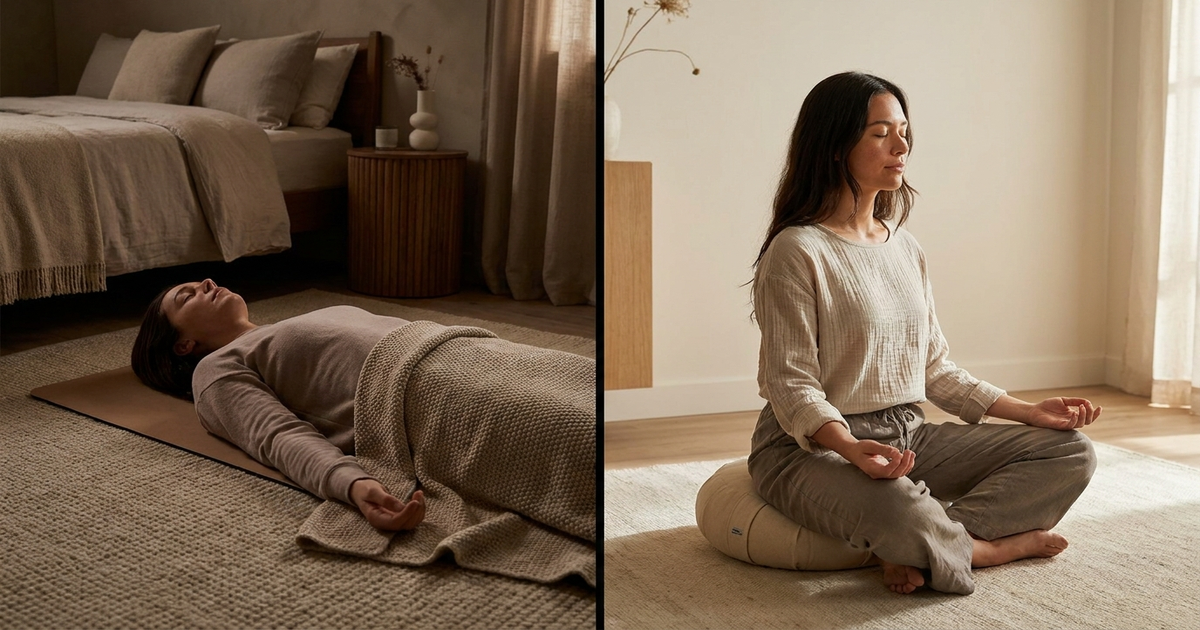
The verdict
- Trying to fall asleep tonight: yoga nidra, done lying down, guided
- Racing thoughts or anxiety you need to process while awake: seated meditation
- Can't sit still or concentrate at night: yoga nidra requires no effort or focus, which is the whole design
- "30 minutes of yoga nidra replaces 2 hours of sleep" is not supported by evidence — sleep researchers call this claim untestable and overstated
- Falling asleep during yoga nidra is fine if your goal is sleep; it only "fails" the practice if your goal was staying aware
Is yoga nidra actually different from meditation, or just meditation lying down?
It's structurally different, not just a change in posture. Seated meditation typically asks you to do something — follow the breath, notice thoughts without judgment, return attention when it wanders — which requires a baseline of alertness to keep doing. Yoga nidra removes that requirement entirely. Cleveland Clinic describes it as a guided practice that moves you through stages of body awareness, breath, and imagery toward the edge of sleep, with a teacher's voice doing the work your own attention would otherwise have to do. A 2025 neurophysiological review found yoga nidra produces measurable slow-brainwave shifts while awareness is still technically maintained — a state distinct from both ordinary wakeful meditation and full sleep. The three-way comparison below shows where the practices actually split.
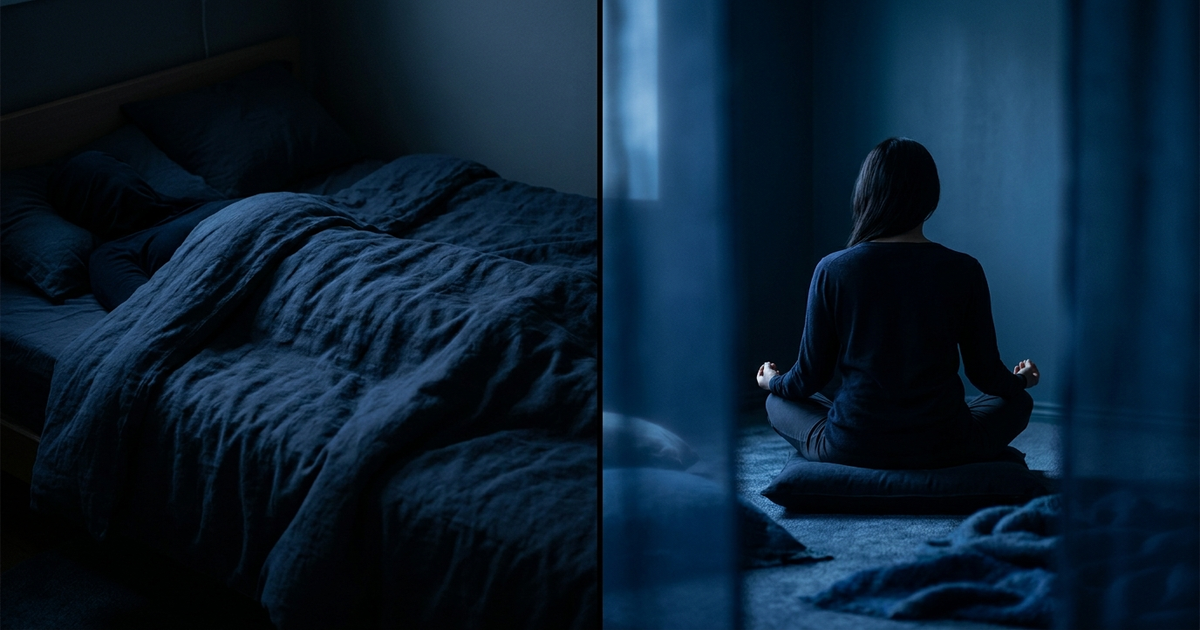
That third column matters because NSDR isn't a separate practice — it's Andrew Huberman's secular rebrand of yoga nidra, built for people who'd try a "nervous-system protocol" but not something labeled a spiritual practice. Some teachers appreciate that framing for lowering the barrier to entry; others point out it strips the origin from an ancient technique while selling essentially the same script. Functionally, the two overlap enough that the same session can serve either name.
Can 30 minutes of yoga nidra really replace 2 hours of sleep?
No — and this is the claim that generates the most pushback from sleep researchers. Even Huberman himself has said there's no evidence yoga nidra equals hours of actual sleep, while noting he personally feels as if he's slept five to six hours afterward — a subjective report, not a measured equivalence. Psychiatrist and sleep specialist Dr. Alex Dimitriu has been blunter, stating that NSDR "is definitely not comparable to real sleep." Sleep researcher Dieter Riemann goes further, arguing the study needed to actually prove the replacement claim essentially can't be run — you can't ethically deprive people of real sleep long enough to test whether 30 minutes of nidra substitutes for it. What yoga nidra likely does is lower cortisol and arousal enough to feel restorative, which is real and useful, but a feeling of restoration isn't the same as the physiological work of REM and deep sleep. Treat it as a genuine tool for downregulation, not a sleep-debt workaround.
I have racing thoughts and can't sit still to meditate — will yoga nidra work better for me?
Almost certainly, yes. Seated meditation asks you to notice a wandering mind and gently redirect it, which is exactly the skill that's hardest to access when you're wired and exhausted at 11 p.m. Yoga nidra sidesteps that requirement — you're lying down, a voice is guiding every step, and there's no concentration to fail at. Multiple teachers describe it as "impossible to mess up" for this reason, which is why it tends to work better than sitting meditation for people who are anxious, overstimulated, or just too tired to hold attention on anything. If your racing thoughts are more of a daytime anxiety pattern than a bedtime one, that's a different problem with a different tool, and worth addressing separately from tonight's sleep routine.
Which practice fits your actual problem tonight?
Most guides treat "yoga nidra or meditation" as one blanket question, but the right answer depends on what's actually keeping you up. If you can't fall asleep in the first place because your mind won't slow down, a guided yoga nidra session is the more direct fix — it does the slowing down for you. If you're wired-and-tired, running hot from the day rather than mentally looping, a short structured breathing pattern before you even start nidra can bring your physiology down first; the 4-7-8 breathing technique built specifically for winding down before bed is worth running for two or three minutes as a bridge into a longer nidra session. If your problem is staying asleep or waking at 3 a.m., a shorter 10–15 minute nidra track is more realistic than starting a full seated practice half-asleep. And if you're new to any of this and want a script that walks you through the basics rather than winging it, a plain beginner-level walkthrough for lying-down relaxation practice is a gentler starting point than either a serious nidra teacher or a silent sitting session.
As Huberman puts it in the session above, the practice's real value is control, not sleep replacement: "Non-sleep deep rest is a powerful tool that can allow you to control the relaxation state of your nervous system and your overall state of mind."
"Non-sleep deep rest is a powerful tool that can allow you to control the relaxation state of your nervous system and your overall state of mind."
Is it okay to fall asleep during a session, or in bed instead of on the floor?
If your goal is sleep, falling asleep mid-session is a success, not a mistake. Traditional yoga nidra teaching does distinguish between falling asleep (losing awareness) and reaching the deeply relaxed but aware state the practice is named for — but that distinction only matters if your goal is the awareness itself. For a nighttime audience, teachers consistently say drifting off is fine. The same goes for location: doing yoga nidra in bed instead of on a yoga mat on the floor doesn't reduce its effectiveness for sleep — the floor tradition exists mostly for daytime practice, where a bed would defeat the purpose by making you too comfortable to stay aware. At night, comfortable enough to fall asleep is exactly what you want.
Which is better for actual insomnia — yoga nidra or CBT-I?
They're not competing for the same job. CBT-I is the evidence-based clinical treatment for chronic insomnia, built around changing the behaviors and thought patterns that keep insomnia going. Yoga nidra is a relaxation tool, and a 2025 RCT protocol out of Rishikesh is comparing it directly against sleep education for medical students — a useful head-to-head, but a much lower evidence bar than CBT-I clears. A separate trial (NCT06888336) is currently recruiting to test yoga nidra specifically for insomnia paired with post-traumatic stress symptoms, which signals researchers see it as a plausible add-on for trauma-linked sleep problems, not a replacement for structured treatment. If your insomnia has lasted more than a few weeks, yoga nidra is worth layering in as a nightly wind-down, but it shouldn't be the only tool you're relying on.
The bottom line
For getting to sleep tonight, pick yoga nidra: lying down, guided, and built around the exact state you're trying to reach. Save seated meditation for daytime anxiety or for building a concentration practice that isn't tied to your bedtime at all. Ignore any claim that a session replaces real sleep — the researchers behind that idea have publicly walked it back — and don't worry if you drift off partway through. That's the outcome you were after.
Transparency note: This article was researched and written by Chester Takau with AI assistance for research gathering and drafting. All recommendations reflect the author's own editorial judgment.
Comments
Post a Comment