- Get link
- X
- Other Apps
The Digital Detox Before Bed Routine That Actually Sticks
By Chester Takau · July 2026
A digital detox before bed routine means setting a fixed cutoff time for screens, moving the phone physically out of arm's reach, and replacing that scrolling window with a short, repeatable wind-down instead of just "trying to stop." A February 2026 American Academy of Sleep Medicine survey of 2,007 U.S. adults found 38% say doomscrolling before bed makes their sleep worse — 46% among 18–24-year-olds — and only 14% never check a device at bedtime. The routine below is built around what that survey and the newer research behind it actually show: the fix isn't one universal rule, it's picking the right lever for whether your problem is timing, content, or habit.
The short version
- A 30–60 minute screen cutoff before bed, phone charging out of reach, is the version backed by current evidence
- Blue light alone is a smaller factor than once claimed — arousing content and app design likely matter more
- Have a concrete swap ready before 9 p.m., not a vague "read instead" plan
- An e-ink reader is a reasonable middle ground; a feed-based app on any screen is not
- The habit of reaching for the phone is solved by distance, not willpower alone
How long before bed should I actually stop looking at screens?
Thirty minutes is the realistic floor, sixty is where most of the measurable benefit shows up. The AASM's standing guidance points to that same 30–60 minute window, and it lines up with a 2025 randomized-crossover meta-analysis in Frontiers in Neurology testing blue-light-blocking interventions against actigraphy-recorded sleep — the effect is real but modest, not the dramatic "one glance ruins your night" framing that circulates online. Ninety minutes is worth aiming for if you're prone to racing thoughts, since it gives your nervous system more time to downshift before you're lying still with nothing to distract it. The number matters less than whether you actually stop at it — a "30-minute rule" you break most nights does less than a strict 15-minute one you keep.
Is it the blue light that's the problem, or is it the content keeping my brain wired?
Increasingly, researchers point to the content. An August 2025 piece from Advisory.com, built on emerging expert consensus, argues that stimulating, emotionally charged material — an argument thread, breaking news, an algorithmic feed engineered to keep you swiping — raises cortisol and mental arousal in a way that plain screen brightness doesn't. That's a real shift: sleep neuroscientist Matthew Walker and researcher Michael Gradisar have both since softened their earlier hard-line blue-light warnings, and the National Sleep Foundation has said there isn't strong enough evidence that pre-bed blue light alone meaningfully delays sleep for most adults. The practical takeaway is to treat blue light and content as two separate problems: a warm-toned screen filter addresses the first, but only closing the app addresses the second, and most people's real issue is the second one.
Walker himself is a useful example of how unsettled this debate still is. In an interview with FoundMyFitness, describing the Harvard/Brigham study comparing iPad reading to print books, he says: "iPad reading dropped or blunted melatonin by over 20%. The peak of melatonin didn't arrive until three hours later." That finding is genuine — but it's worth hearing as one side of an evolving argument rather than settled fact, since Walker has since acknowledged the newer content-focused research complicates the simple blue-light story.
Where should I actually keep my phone at night — nightstand, another room, or somewhere in between?
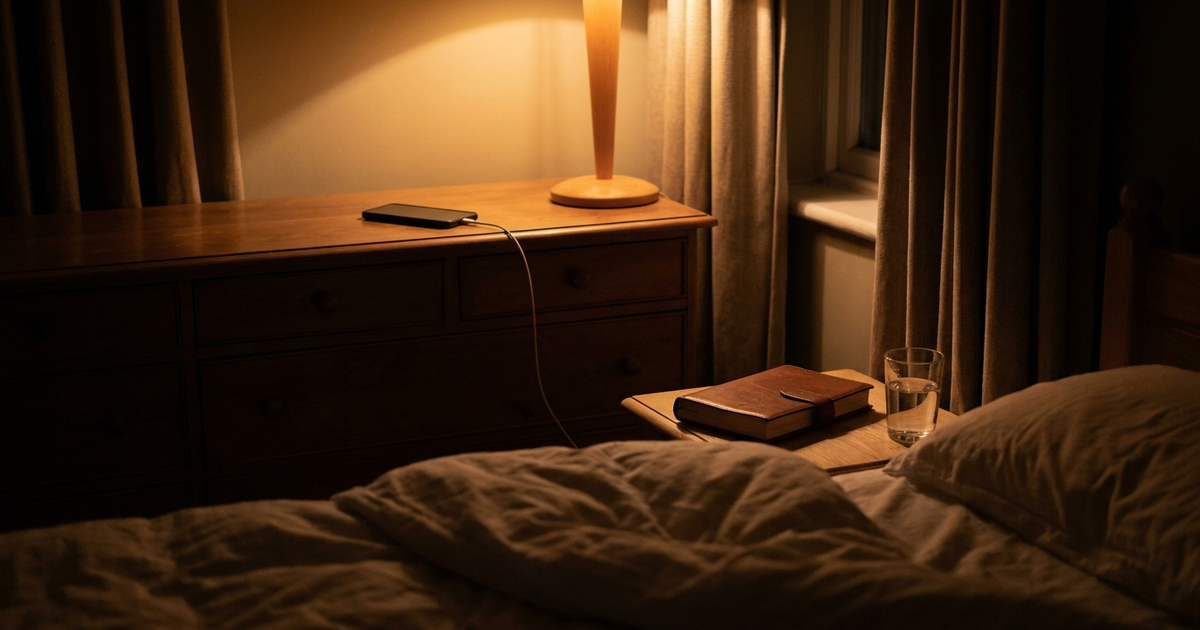
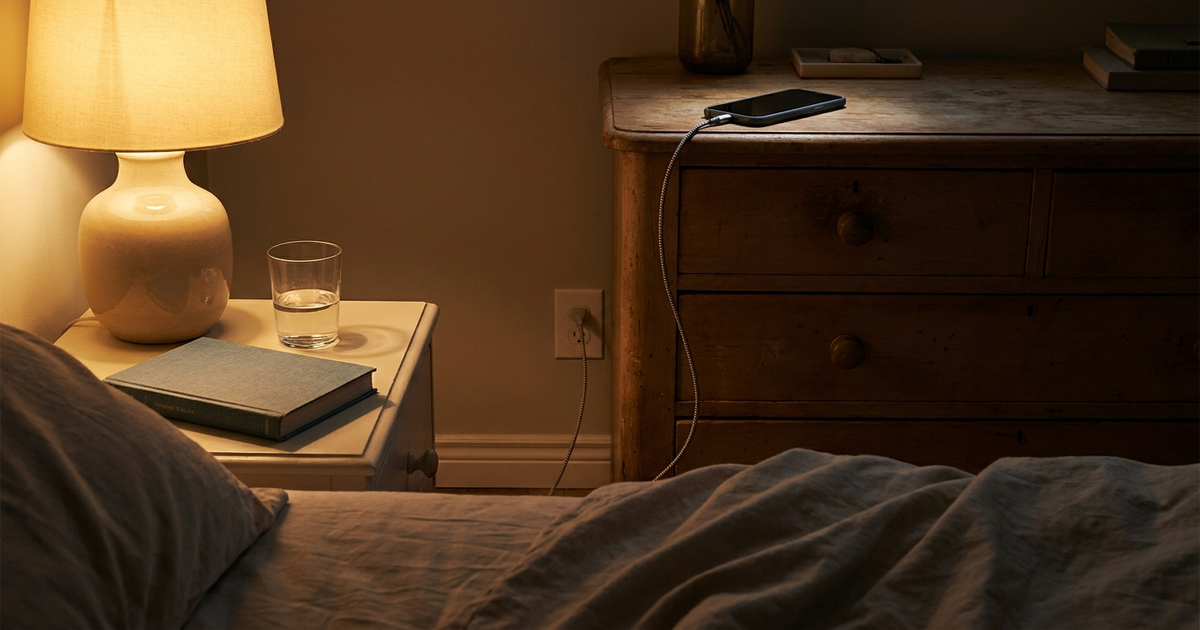
Across recovery forums, tech coverage, and sleep research, one change gets cited more consistently than any other: physically charging the phone somewhere you can't reach it from bed. Tom's Guide reporting on personal phone-addiction fixes names this specifically as the change that worked when every app-based timer failed. A full other-room ban isn't required to get the benefit — a dresser across the bedroom, or a hallway charging spot just outside the door, removes the same reflexive reach-and-check while still keeping the phone close enough to hear for emergencies. The nightstand is the one place that defeats the purpose, since it's exactly within reach the moment you can't sleep.
What do I actually do for that hour instead of scrolling?
Most digital detox advice stops at "read a book," which is exactly why it fails the first night you're not in the mood to read. A timed swap works better: the first 15–20 minutes for something physical — tidying up, a shower, laying out tomorrow's clothes — the next 20 minutes for a screen-free activity like reading or light stretching, and the last 15–20 minutes for something that actively downshifts your nervous system rather than just occupying your hands. If lying still with your own thoughts is the hardest part of that last stretch, a step-by-step beginner session in guided relaxation gives you a script to follow instead of blank silence, which is often what sends people back to their phone in the first place.
Do blue-light glasses or a warm "night mode" filter actually work?
Somewhat, but don't expect them to fix a scrolling habit. The 2025 Frontiers in Neurology meta-analysis of randomized crossover trials found measurable effects on actigraphy-based sleep outcomes from blue-light-blocking glasses, but the size of that effect is modest next to what content and timing changes produce. Night mode and blue-light glasses are worth using — there's no real downside — but they solve the light half of the problem while leaving the arousal half completely untouched. If you put on blue-light glasses and then spend forty minutes doomscrolling anyway, you've addressed the smaller variable and ignored the bigger one.
Is reading on a Kindle or other e-ink device okay, or is any screen bad before bed?
E-ink is a reasonable middle ground, and it's a meaningfully different device from a phone or tablet for this purpose. A dedicated e-reader emits far less blue light than an LCD or OLED screen, and — just as importantly — it can't push a notification, refresh a feed, or tempt you into "just checking" something else. The distinction that matters isn't "screen versus no screen," it's whether the device can pull you into content designed to keep you engaged. A Kindle loaded with a novel is closer to a paperback than to a phone; a phone running a Kindle app, sitting one swipe away from your email and social feeds, is not.
I keep breaking my own rule and reaching for my phone in bed — how do I actually stop that?
Treat it as a distance problem before you treat it as a discipline problem. If the phone is charging across the room, breaking the rule requires physically getting up, which filters out most idle, half-conscious reaching. This is also a stimulus-control principle borrowed directly from clinical insomnia treatment — keeping the bed and bedroom associated with sleep, not scrolling, is one of the core techniques covered in the home-based cognitive behavioral therapy program for insomnia, and it works on the same logic here: your brain learns what the bed is for based on what you consistently do there. If out-of-reach charging alone doesn't hold, add a second layer — a full app lock or a scheduled downtime mode — rather than relying on remembering not to pick it up.
Does using my phone as an alarm clock ruin the whole routine?
Only if it's the reason the phone stays on your nightstand. A ten-dollar analog alarm clock removes the single most common justification people give for keeping their phone within reach overnight, and it closes the loop on the "but I need it to wake up" objection before it undoes everything else in the routine. If you genuinely need a phone-based alarm — for a backup, a specific tone, or shift work — set it, then move the phone to the far side of the room on a stand where the alarm is audible but the screen isn't reachable from bed. The goal isn't removing the phone from your life at night, it's removing it from your hand.
If I wake up at 3 a.m., is checking my phone as bad as scrolling before I first fall asleep?
It's arguably worse, and it's the scenario almost every digital detox guide skips entirely. Checking the time, a notification, or a feed during a middle-of-the-night waking does two things at once: the light and content re-arouse you the same way they would at bedtime, and — because you're already sleep-deprived in that moment — you're more likely to spiral into checking email or news you'd otherwise ignore. If you wake at 3 a.m., the same distance rule applies even more strictly: a phone across the room can't be checked half-asleep, while one on the nightstand almost always gets picked up "just to see what time it is."
How long until I actually notice a difference?
Give it a week before judging it. The registered clinical trial on structured digital detox training for adolescent sleep quality (ClinicalTrials.gov NCT07555834) reflects how recent and still-forming this research is — there isn't a definitive "day 4 is when it clicks" number yet. What sleep clinicians consistently report anecdotally is that the phone-distance change shows results fastest, often within a few nights, while the content and habit changes take longer because they're competing with a genuinely engineered-for-engagement product. 2026 wellness coverage of the "digital sunset" trend frames it the same way: not a one-night fix, but a routine that compounds the more consistently you keep it.
Tonight's actual routine
Pick a cutoff — 30 minutes minimum, 60 if you can manage it — and move your phone to a charging spot you can't reach from bed before you start the clock. Fill the freed-up time with something concrete rather than a vague "wind down," and treat blue-light glasses or night mode as a small bonus, not the main fix, since the content is doing more of the damage than the light. If a 3 a.m. waking happens, the same out-of-reach rule is what keeps a five-minute wake-up from turning into forty-five minutes of scrolling. None of this requires quitting your phone — it requires putting enough distance between you and it that the easy choice, at 11 p.m. or 3 a.m., is the one that lets you get back to sleep. For the timing science behind why consistency matters as much as the cutoff itself, our guide to resetting your body's internal sleep-wake clock covers the mechanism in more depth.
Transparency note: This article was researched and written by Chester Takau with AI assistance for research gathering and drafting. All recommendations reflect the author's own editorial judgment.
Related on MindfulJourneySleep: The Phone Before Bed Sleep Fix That Actually Works (It's Not About the Blue Light)
Comments
Post a Comment